
Best Sellers
Antique Furniture and Decor
Antique Furniture and Decor
Antique Furniture and Decor
Antique and Vintage Seating
Antique Furniture and Decor
Antique Furniture and Decor
Accent chairs
Antique Furniture and Decor
Antique Furniture and Decor
Antique Furniture and Decor
Antique Furniture and Decor


Antique Furniture and Decor
Antique Furniture Guide, Biedermeier, Style
Why Biedermeier Furniture Feels Modern: A Design Analysis
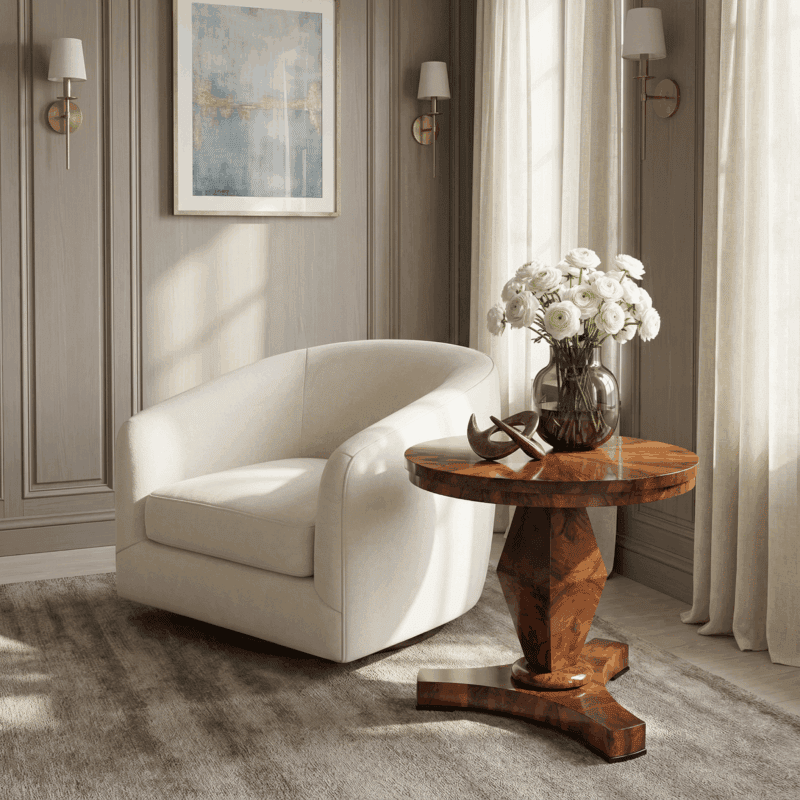
At first glance, Biedermeier furniture belongs firmly to the early 19th century. Emerging in Central Europe between 1815 and 1848, it is often positioned as a historical style—refined, restrained, and rooted in a specific cultural moment.
And yet, when placed in a contemporary interior, Biedermeier pieces feel unexpectedly current.
This is not accidental. The visual language of Biedermeier furniture anticipates many of the principles that define modern design: clarity, proportion, material honesty, and a quiet rejection of excess. Understanding why Biedermeier feels modern reveals not only its lasting appeal, but also its relevance for today’s interiors.
A Shift Away from Ornament
To understand Biedermeier, it helps to consider what came before it.
The preceding Empire style was defined by grandeur—ornament, symbolism, and references to classical antiquity. Furniture was often formal, imposing, and decorative in a way that emphasized status over comfort.
Biedermeier marks a decisive shift.
Instead of elaborate carving or applied decoration, Biedermeier furniture embraces reduction. Surfaces are clean. Lines are uninterrupted. Ornament, when present, is minimal and integrated rather than applied.
This restraint aligns closely with modern design principles. The idea that beauty can emerge from simplicity—rather than embellishment—is a defining characteristic of 20th-century modernism, yet it is already fully present in Biedermeier.
Clarity of Form and Proportion
One of the most striking aspects of Biedermeier furniture is its sense of proportion.
Cabinets, chests, and tables are composed with a clarity that feels almost architectural. Volumes are balanced, silhouettes are precise, and every element serves a visual purpose. There is little ambiguity in form—each piece reads as a coherent whole.
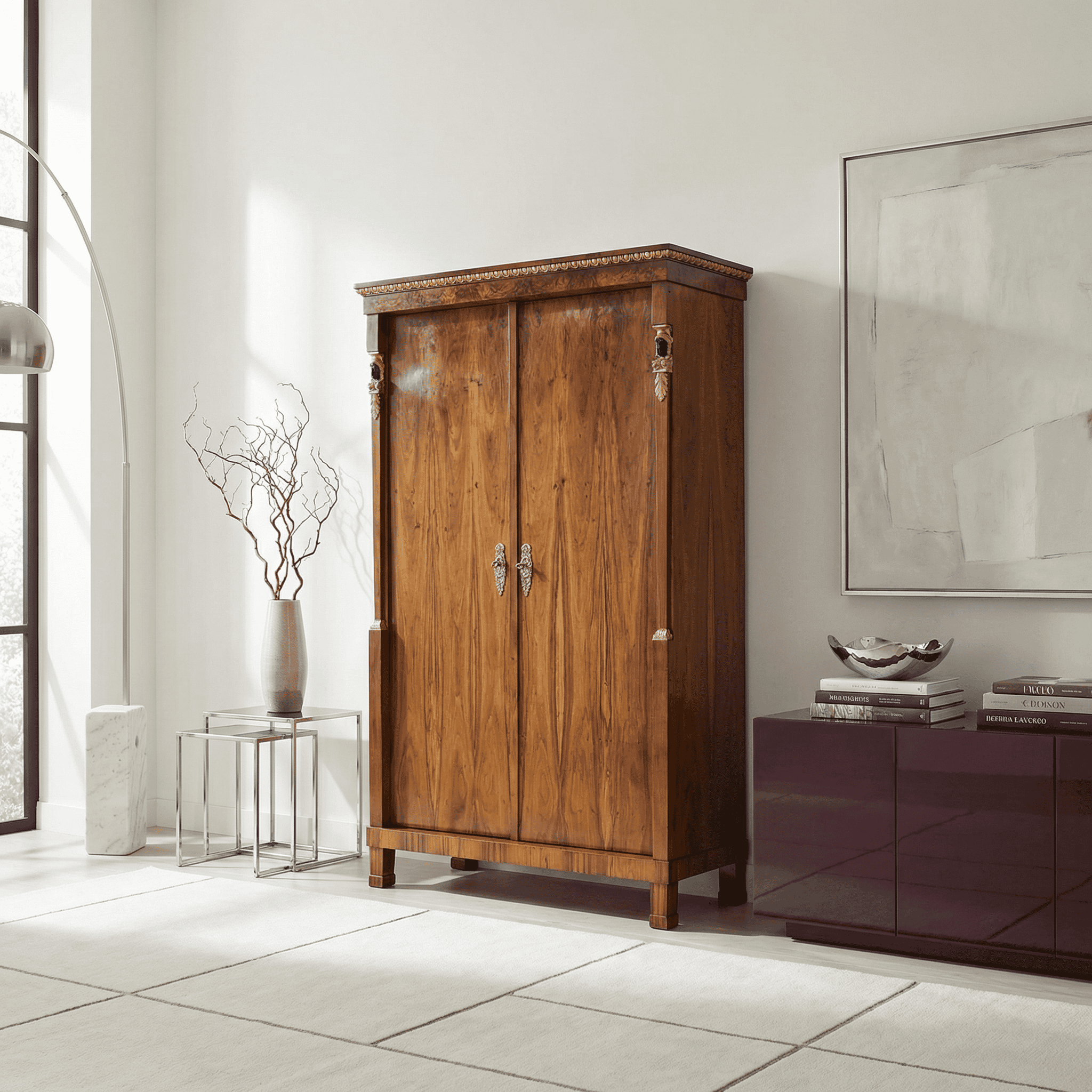
This clarity is deeply aligned with modern design thinking.
Rather than relying on decoration to create interest, Biedermeier furniture relies on:
- Proportion
- Scale
- Balance
These are the same tools used by modern designers to create visual harmony. A well-proportioned Biedermeier chest, for example, can hold its own in a contemporary space not because it contrasts with modern elements, but because it shares the same underlying logic.
Material as the Primary Expression
Perhaps the most important connection between Biedermeier and modern design lies in its treatment of materials.
Biedermeier furniture does not hide its material—it celebrates it.
Walnut, in particular, plays a central role. Rather than being carved or obscured, it is presented as a surface. Veneers are carefully selected and often book matched to emphasize the natural grain, creating subtle yet powerful visual patterns.
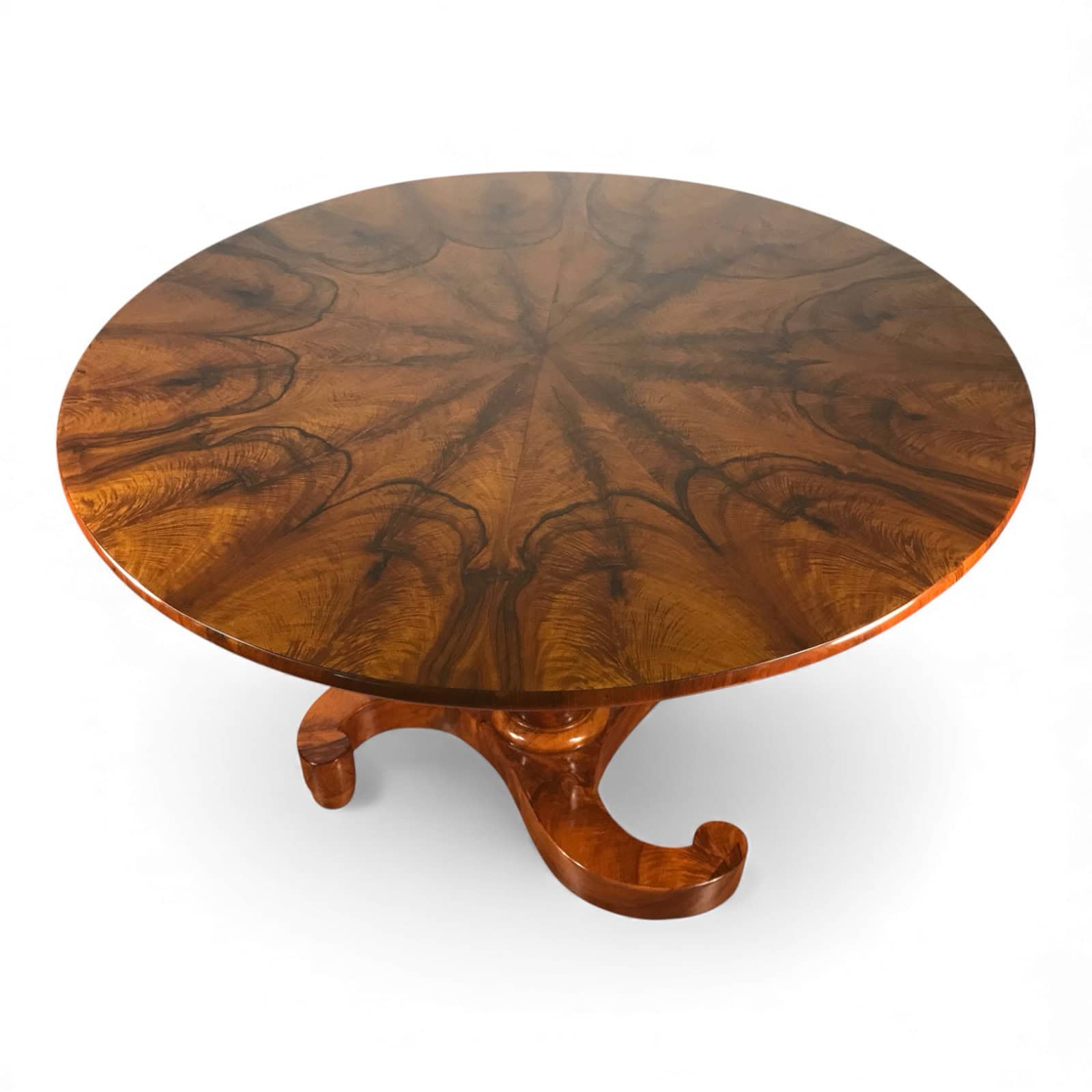
The result is a kind of material minimalism:
- The surface becomes the decoration
- The grain becomes the visual interest
- The craftsmanship becomes visible through restraint
This approach feels remarkably contemporary. Modern design often emphasizes “truth to materials”—the idea that materials should be expressed honestly rather than disguised. Biedermeier achieves this not as a theory, but as a practice.
Designed for Living, Not Display
Another reason Biedermeier furniture feels modern is its relationship to daily life.
Unlike earlier styles that were often designed for formal or ceremonial spaces, Biedermeier furniture was created for the domestic interior. It reflects a shift toward comfort, usability, and a more personal environment.
Pieces are:
- Scaled for real rooms
- Designed for practical use
- Comfortable without being overly ornate
This focus on function aligns closely with modern design philosophy. The idea that furniture should support everyday life—rather than simply represent status—is central to both Biedermeier and contemporary design.
Visual Calm and Restraint
In today’s interiors, there is a growing appreciation for calmness and visual clarity. Spaces are often designed to feel intentional, uncluttered, and grounded.
Biedermeier furniture contributes to this atmosphere naturally.
Because it avoids excessive ornament and relies on proportion and material, it introduces a sense of quiet presence. A single Biedermeier piece can anchor a room without overwhelming it.
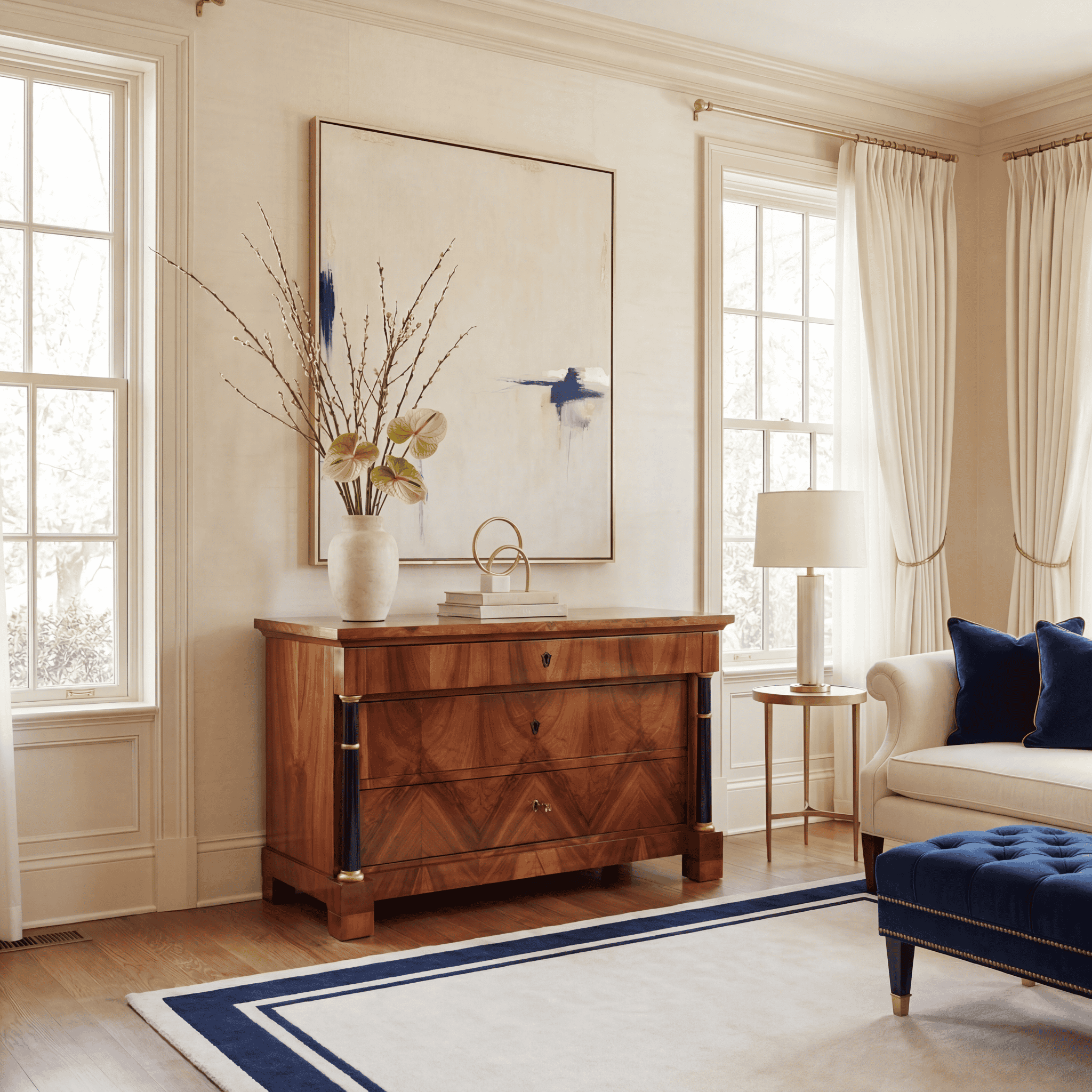
This quality makes it particularly compatible with:
- Contemporary architecture
- Minimalist interiors
- Spaces that emphasize light and material
Rather than competing with modern elements, Biedermeier furniture integrates with them.
A Different Kind of Modernity
It would be easy to say that Biedermeier furniture “looks modern.” But that misses the deeper point.
Biedermeier does not imitate modern design—it anticipates it.
Its emphasis on:
- Simplicity
- Function
- Material
- Proportion
places it closer to modernism than to many of the styles that surround it historically.
This is why Biedermeier pieces can feel at home in interiors that are otherwise entirely contemporary. They share the same underlying values, even if they originate from a different time.
Biedermeier Furniture Today
Today, Biedermeier furniture remains one of the most versatile categories within antique design. From chests and cabinets to tables and seating, well-preserved pieces continue to offer both functional value and strong visual presence.
Biedermeier furniture is not just historically significant—it is visually and conceptually relevant. It bridges the gap between antique and modern in a way that few styles can.
A well-chosen Biedermeier piece does not feel like an addition from the past. It feels like a continuation of a design language that remains current.
For those looking to incorporate Biedermeier furniture into their interiors, the key lies in selecting pieces with clarity of form, high-quality veneer, and balanced proportions—qualities that define the style at its best.
Conclusion
The enduring appeal of Biedermeier furniture lies in its clarity.
By reducing ornament, emphasizing material, and focusing on proportion and function, it achieves a kind of timelessness that resonates strongly today. Its modernity is not superficial—it is structural.
In this sense, Biedermeier is not simply a historical style that fits into contemporary interiors. It is a reminder that many of the ideas we associate with modern design have deeper roots—and that the most enduring furniture is often the most restrained.

Silke Berlinghof
People also buy
Antique Furniture and Decor
Antique Furniture and Decor

Antique Furniture and Decor
Antique Furniture and Decor
Antique and Vintage Seating
Antique Furniture and Decor

Antique Furniture and Decor
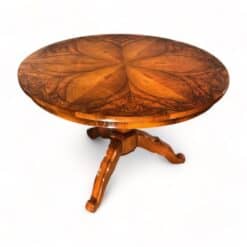
Antique Biedermeier Center Table, South German 1820-25, Walnut
Antique Furniture and Decor
Antique Furniture and Decor
Antique Furniture and Decor
Antique Furniture and Decor