Best Sellers
Antique Furniture and Decor
Floor and Table Lamps`

Antique Furniture and Decor
Fine Art and Sculptures
Coffee Tables
Resources, Styylish Research Library
How We Identified a Pair of Early Fukagawa Seiji Porcelain Vases
Researching Japanese Porcelain Marks and the Story Behind an Elegant Pair of Early Fukagawa Seiji Porcelain Vases
One of the most rewarding aspects of dealing in antiques is that every object has a story waiting to be uncovered. Sometimes that story is immediately apparent through a signature or documented provenance. More often, however, it begins with careful observation, followed by research that combines art history, maker’s marks, published references, and comparisons with museum collections.
A recent pair of Japanese porcelain vases offered us exactly that opportunity.
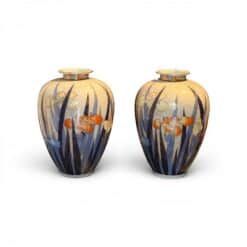
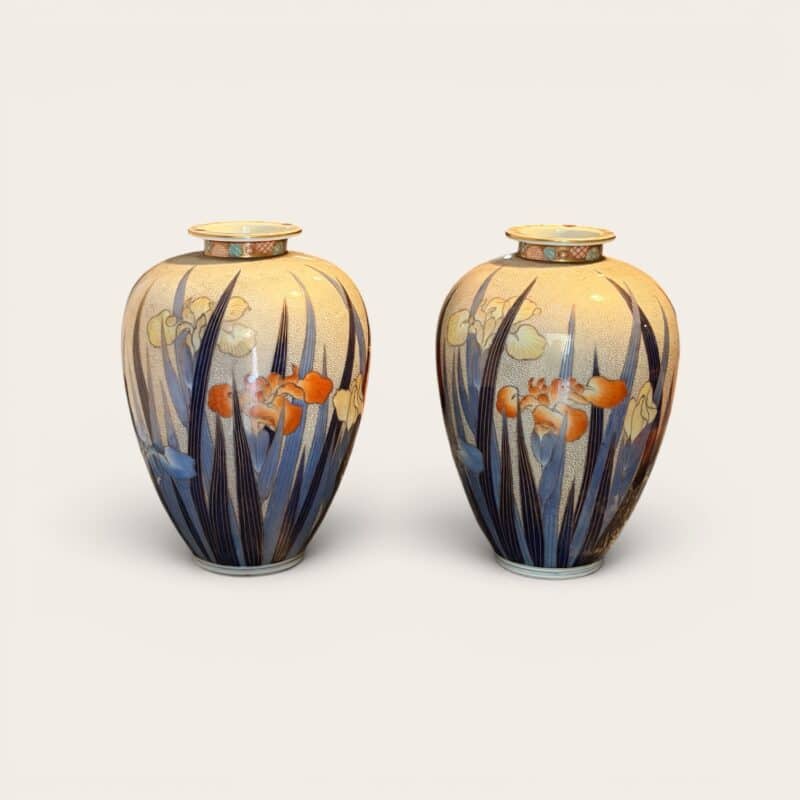
At first glance, the vases impressed us through their elegant proportions and refined decoration. Measuring 32 cm (12.6 in.) in height, each vase is hand-painted with blooming Japanese irises in luminous underglaze cobalt blue, accented by delicate orange and cream enamels. The flowers stand against an intricate gilt karakusa (scrollwork) ground, while a geometric border inspired by traditional Japanese textiles frames the neck.
The quality of the porcelain and the painting immediately suggested that these were not ordinary export wares.
The First Clue: A Blue Underglaze Mark
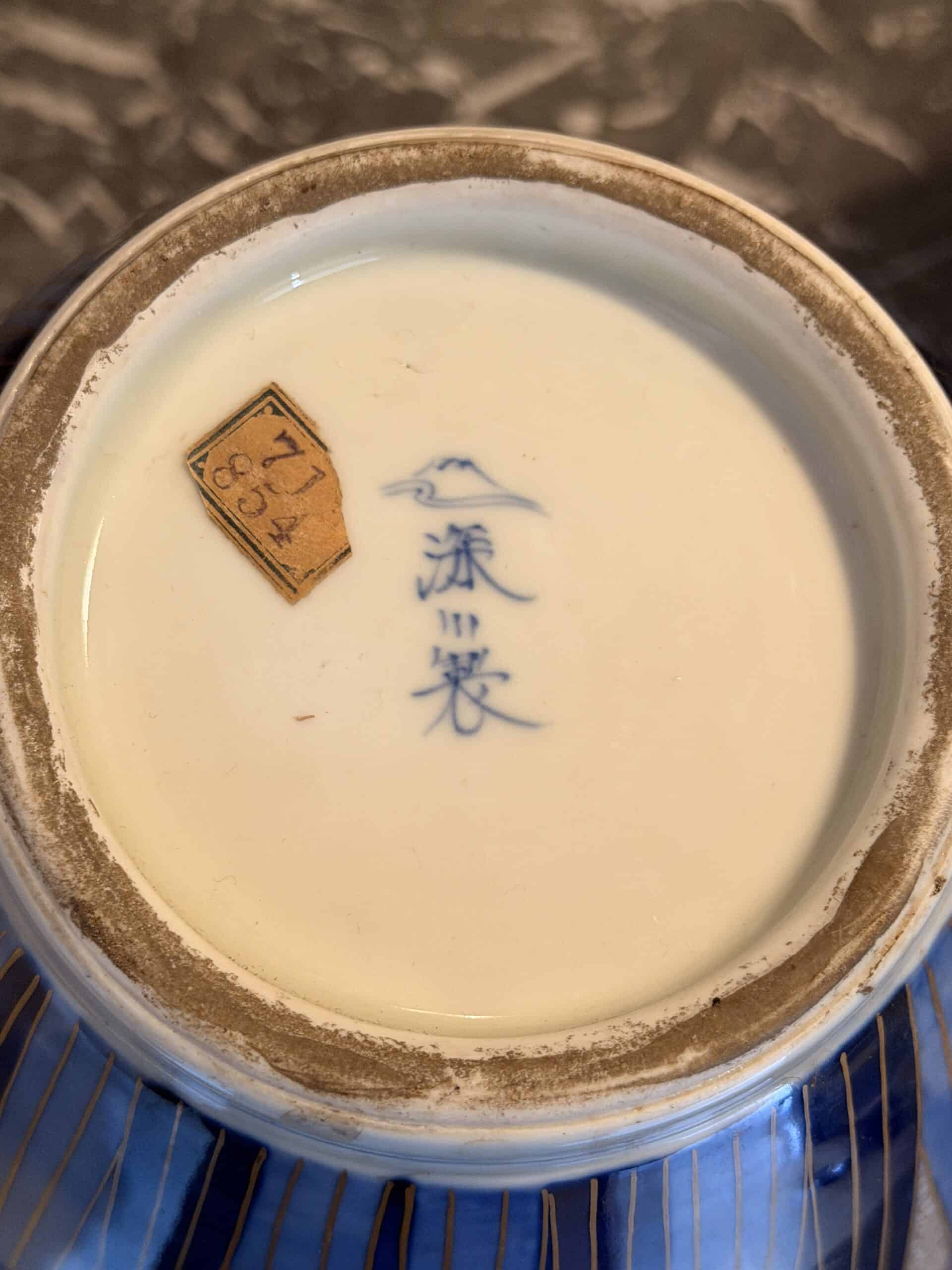
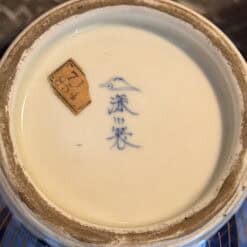
Turning the vases over revealed an underglaze blue mark beneath each base. Above three Japanese characters appeared a stylized image of Mount Fuji with flowing water.
At first, the mark was difficult to interpret. Japanese porcelain marks are often written in highly calligraphic script, making individual characters challenging to read. Our initial reading proved inconclusive, so we compared the mark with documented examples from Japanese porcelain references and museum collections.
The research soon pointed to one of Japan’s most distinguished porcelain manufacturers.
Identifying the Maker
The mark corresponds to the well-documented trademark of Fukagawa Seiji (深川製磁), founded in Arita in 1894 by Fukagawa Chūji.
The characters 深川製 translate as “Made by Fukagawa.” Above them appears the company’s distinctive Mount Fuji and flowing water trademark, used on many of its early twentieth-century porcelain productions.
Fukagawa Seiji quickly became internationally recognized for combining the centuries-old traditions of Arita porcelain with a refined decorative language that appealed to both Japanese and Western collectors. The company received international awards at world’s fairs and later became an official supplier to the Imperial Household of Japan.
Today, early Fukagawa porcelain is appreciated for its exceptional craftsmanship, brilliant white porcelain body, and vivid underglaze cobalt blue, often referred to by collectors as “Fukagawa Blue.”
Dating the Vases
Dating Japanese porcelain is rarely based on a single detail. Instead, it relies on the combination of several observations.
The documented Fukagawa mark, the elegant baluster shape, the restrained palette, and the refined hand-painted decoration all suggest production during the late Meiji to early Taishō period, approximately 1905–1920.
While further research may refine this date, the stylistic and historical evidence consistently supports an early twentieth-century attribution.
Why the Decoration Matters
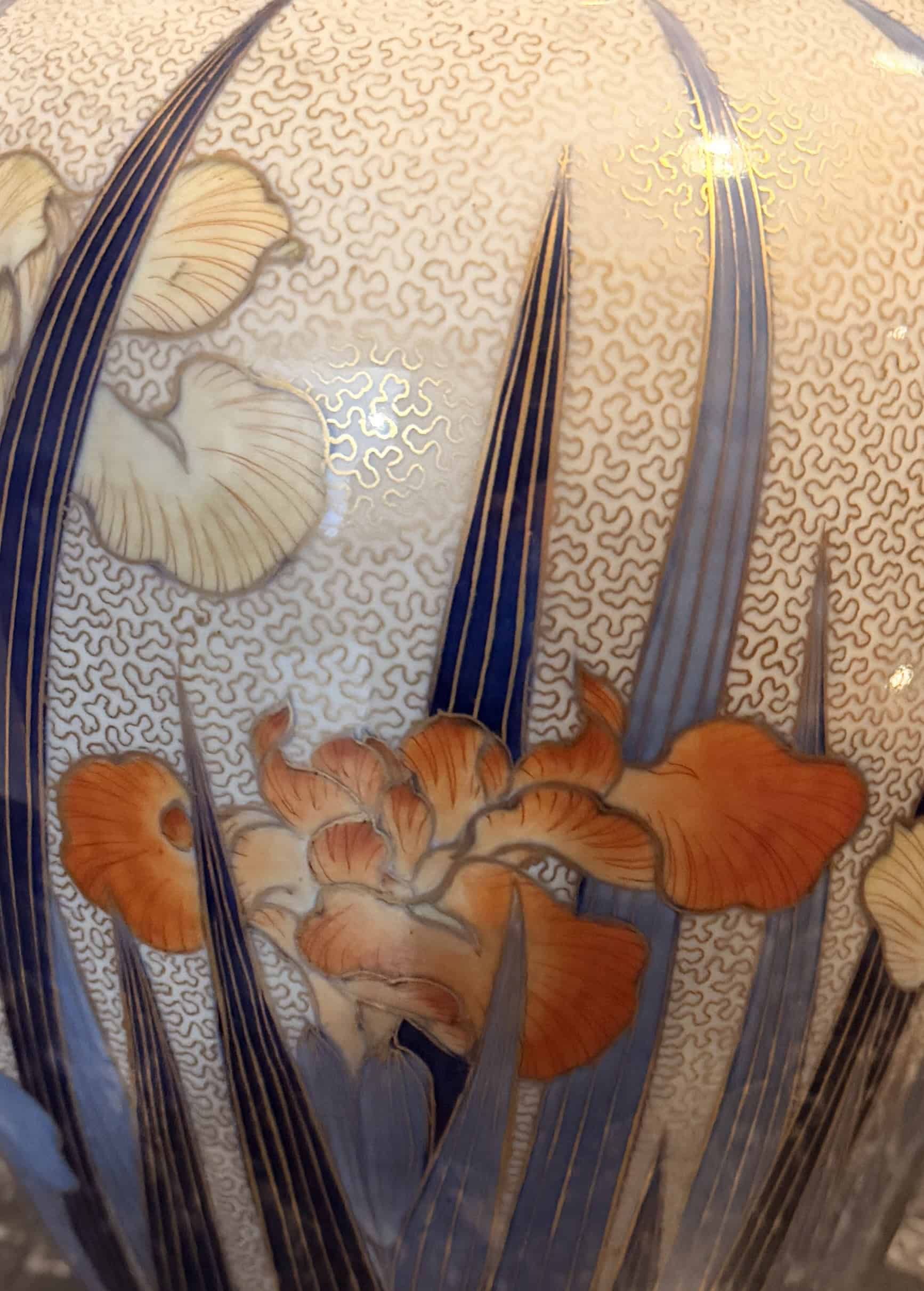
The decoration also provides important clues.
Rather than using heavily ornamented scenes often associated with later export porcelain, these vases focus on a single floral subject: the Japanese iris (hanashōbu).
In Japanese culture, the iris symbolizes elegance, renewal, and the arrival of early summer. During the late nineteenth and early twentieth centuries, Fukagawa embraced naturalistic floral motifs such as irises, wisteria, and morning glories, reflecting both traditional Japanese aesthetics and the growing influence of Art Nouveau.
The exceptionally fine gilt karakusa background further distinguishes this pair. Such labor-intensive decoration was typically reserved for higher-quality decorative pieces, demonstrating the level of craftsmanship for which Fukagawa became internationally renowned.
The Mystery of the Paper Label
One intriguing detail remains unresolved.
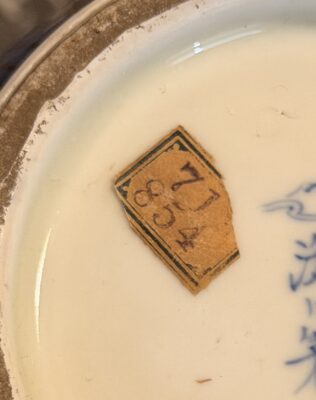 Each vase retains part of its original paper label. Although incomplete, the surviving fragments suggest that it is not a factory label but rather a retailer’s or export merchant’s inventory label.
Luxury Japanese porcelain destined for Europe and North America often passed through export merchants in Yokohama or Kobe before reaching Western retailers. Additional labels were commonly applied during this process.
We continue to research this label and hope to identify the retailer or exporter associated with these vases. Should new information emerge, we will update this article.
Why Research Matters
Many antique listings simply state an attribution. At Styylish, we believe it is equally important to explain why an attribution is made.
Researching maker’s marks, consulting historical references, and comparing documented examples allows us to present objects with greater confidence and transparency. It also deepens our appreciation of the artisans and workshops behind these remarkable pieces.
Every exceptional object deserves more than a description—it deserves its story.
The Continuing Journey
Research is rarely finished. New publications, museum acquisitions, and digitized archives continue to shed light on historic makers and decorative arts.
This pair of early Fukagawa Seiji porcelain vases reminds us that collecting is not only about ownership but also about discovery. Every mark, label, and decorative detail offers another piece of the puzzle, connecting us with the artists, workshops, and collectors who came before us.

Silke Berlinghof
People also buy
Fine Art and Sculptures
Antique Furniture and Decor
Ceramics